Choosing an FRP cooling tower is not simply a matter of matching a catalog capacity to a process name. The tower has to reject the required heat at the site’s actual wet-bulb condition while coping with circulating-water chemistry, airborne contaminants, operating hours, noise limits, maintenance access, and the plant’s control strategy.
This selection guide is written for engineers, plant owners, contractors, and procurement teams who need to specify an FRP cooling tower for HVAC, power, chemical processing, water treatment, food production, and other industrial cooling-water systems. It explains what information should be defined before requesting a quotation and how to compare proposals on a technically consistent basis.
A well-selected FRP cooling tower should meet the design duty without creating avoidable problems in water consumption, fan energy, drift control, inspection, or replacement access. The following process turns a broad purchase request into an auditable equipment specification.
ماذا ستتعلم:
- Which thermal inputs determine the required cooling duty
- How counterflow, crossflow, induced-draft, and forced-draft layouts differ
- How to review casing, structure, fill, fan, and water-distribution details
- Why water treatment, drift control, access, and maintenance belong in the original specification
- What to include in an RFQ so suppliers can size the equipment correctly
جدول المحتويات
How an FRP Cooling Tower Works in an Industrial Loop
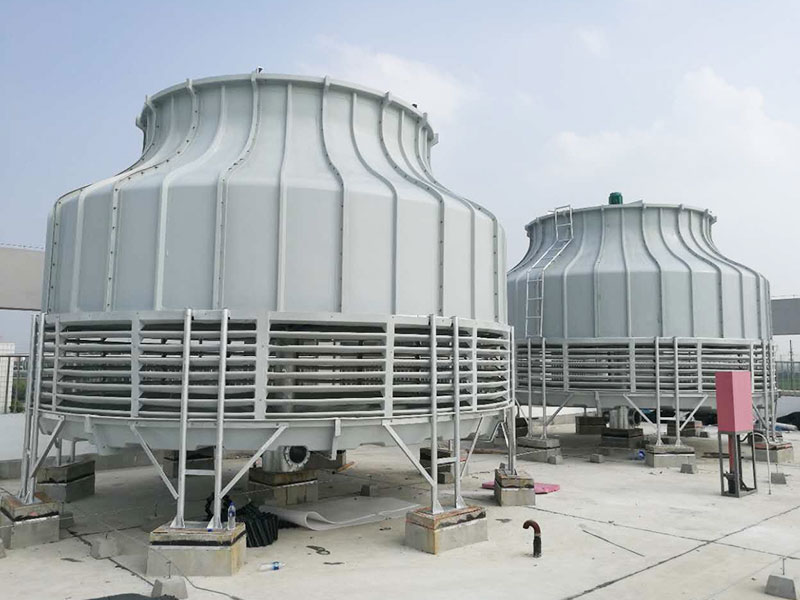
An FRP cooling tower removes heat from circulating water by bringing the water into contact with moving air. A small portion of the water evaporates, carrying heat to the atmosphere, while the cooled water returns to the process, chiller condenser, heat exchanger, or other equipment.
The basic FRP cooling tower system includes a hot-water inlet, distribution system, heat-transfer fill, fan and drive, drift eliminators, air inlets, cold-water basin, casing, and supporting structure. Each component affects thermal output, pressure drop, water loss, sound, reliability, and service access. The FRP cooling tower product page provides an overview of the available equipment, while this guide focuses on the inputs needed for responsible selection.
Start With the Required Thermal Duty
Every FRP cooling tower selection should begin with four connected values: circulating-water flow, entering hot-water temperature, leaving cold-water temperature, and design entering-air wet-bulb temperature. The temperature drop from hot water to cold water is the range. The difference between cold-water temperature and wet-bulb temperature is the approach.
A smaller approach generally demands more heat-transfer capability because the desired cold water is closer to the natural evaporative limit. The ASHRAE cooling tower chapter explains that range is determined by heat load and water flow rather than tower size alone. For that reason, a supplier cannot accurately size an FRP cooling tower from flow rate or nominal process capacity by itself.
Before sizing an FRP cooling tower, use site-specific weather data and the real peak operating condition. Also identify whether the specified duty is continuous, seasonal, or intermittent; whether future heat load is expected; and whether multiple cells must provide turndown or standby capacity. State the allowable pressure loss and available electrical supply at the same time.
Choose the Airflow and Water-Flow Configuration
A counterflow FRP cooling tower moves air upward while water travels downward through the fill. This layout can offer a compact footprint, but the pressurized distribution system and internal access requirements must be reviewed. A crossflow design moves air horizontally across falling water and often provides easier access to gravity-fed distribution basins, although the plan area may be larger.
Induced-draft FRP cooling tower units place the fan at the air discharge and pull air through the tower. Forced-draft units push air into the inlet. Neither arrangement is automatically best for every plant. The decision should consider recirculation risk, fan access, winter operation, sound direction, discharge velocity, space, and the surrounding structures.
Ask suppliers to identify the proposed configuration rather than accepting the general label “industrial FRP cooling tower.” Compare the actual casing dimensions, cell arrangement, air path, basin design, fill volume, fan location, and maintenance clearances.
Review FRP Materials and Structural Details
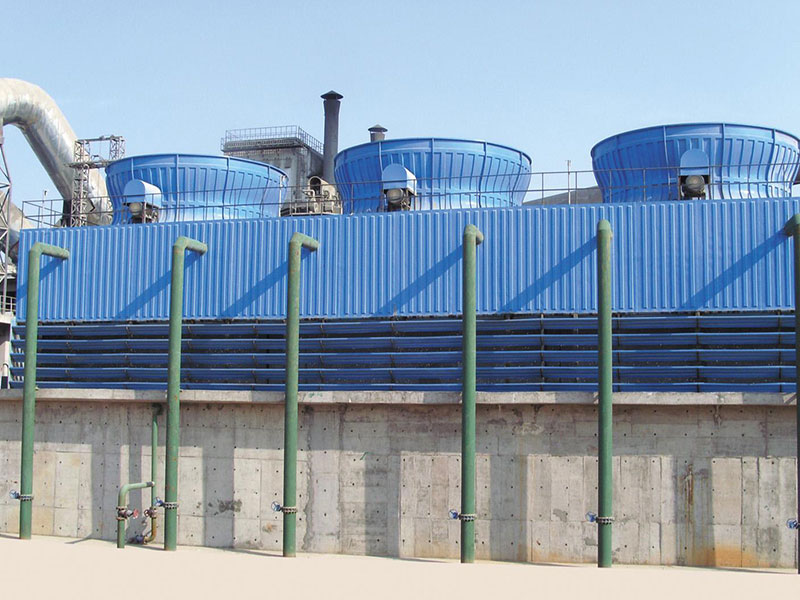
FRP is attractive in wet, chemically treated environments because the composite does not rust like unprotected carbon steel. However, “FRP” is not a complete material specification. Resin chemistry, glass reinforcement, laminate construction, surface protection, joint details, ultraviolet exposure, fire-performance needs, and the compatibility of fasteners all influence service suitability.
For an FRP cooling tower near aggressive process emissions or saline air, provide the supplier with expected contaminants and water-treatment chemicals. The supplier should confirm the proposed laminate or pultruded structural material for those conditions. Review whether load-bearing members, casing panels, louvers, ladders, handrails, and platforms use FRP or another specified material.
Do not assume every FRP cooling tower component shares the casing’s corrosion behavior. Motor frames, fan hubs, shafts, bearings, bolts, anchors, nozzles, piping supports, and access hardware may use different materials. The broader لماذا صفحة فرب explains the material’s industrial advantages, while the FRP pipes and fittings guide is useful when the cooling-water loop also requires corrosion-resistant piping.
Verify Thermal Performance at the Operating Point
A credible FRP cooling tower proposal should state the design flow, hot-water temperature, cold-water temperature, wet-bulb temperature, fan power, air quantity, and the conditions used for rating. If any input differs between bids, the results are not directly comparable.
Ask how the FRP cooling tower performance was calculated and whether an independent thermal-performance requirement applies to the project. The Cooling Technology Institute certification program describes how CTI Standard 201 relates to published thermal ratings. If certification is required, verify the exact proposed model or model line in the relevant directory instead of assuming that a company-level statement covers every unit.
Also request FRP cooling tower part-load information when the heat rejection duty varies. Multiple cells, variable-speed fans, or staged operation can help match output to changing demand, but the control sequence must maintain water distribution and avoid long stagnant periods.
Plan Water Quality and Biological Control
FRP cooling tower corrosion resistance does not remove the need for water management. Scale, suspended solids, biofilm, biological growth, and poor chemical control can reduce heat transfer, restrict nozzles, damage components, and create health risks. Water-treatment specialists should review make-up water quality, target cycles of concentration, blowdown control, filtration, chemical dosing, and monitoring.
ال CDC cooling tower control guidance emphasizes design features, drift eliminators, avoidance of stagnation, automated treatment, routine monitoring, cleaning, and a site-specific water management program. OSHA’s Legionella control guidance also addresses evaporative cooling equipment and worker exposure.
Specify removable strainers, accessible basins, drain points, inspection access, and a distribution system that can be cleaned. An FRP cooling tower should be located and piped so operators can safely inspect the basin, fill, eliminators, nozzles, and mechanical equipment. Local health, environmental, and discharge requirements must be identified by the project team.
Water efficiency is also an operating issue. The EPA WaterSense best-management-practices page highlights cooling-tower management as part of reducing mechanical-system water use. Use conductivity-based blowdown and treatment limits established for the actual make-up water rather than pursuing a generic cycles-of-concentration target.
Evaluate Fans, Motors, Noise, and Controls
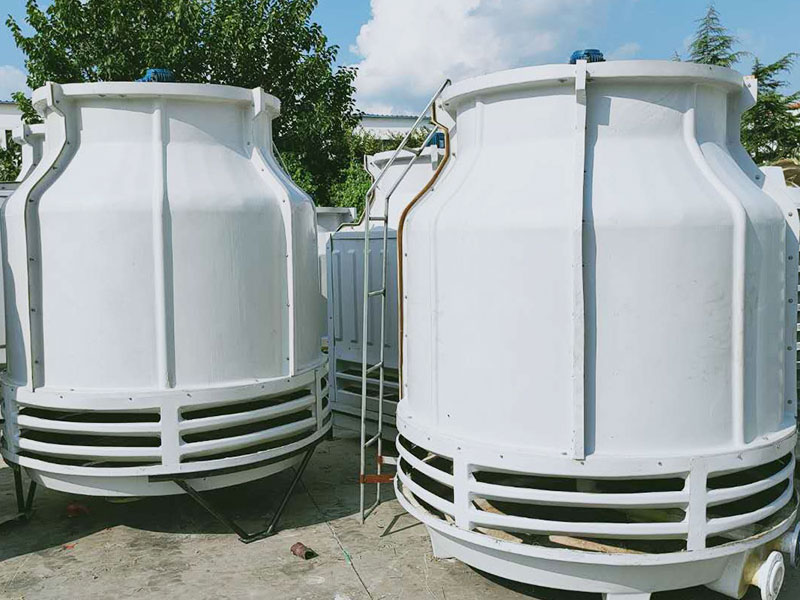
The FRP cooling tower fan system is a major source of electrical demand and sound. Compare motor efficiency, rated power, fan material, blade adjustment, drive type, guards, vibration control, bearing access, and the proposed starting or speed-control method. Confirm whether the stated sound data applies at the project’s measurement point and operating condition.
A variable-frequency drive can improve part-load control, but minimum speed, motor suitability, resonance ranges, gearbox requirements, water-temperature control, and multi-cell sequencing still need engineering review. For an FRP cooling tower serving sensitive production, include alarm points for basin level, outlet temperature, fan status, vibration where applicable, and water-treatment controls.
If the equipment serves electrical or utility infrastructure, the site’s reliability and access requirements may overlap with considerations in the FRP power and substation applications article.
Check Site Layout, Piping, and Maintenance Access
Even a correctly sized FRP cooling tower can underperform if hot, moist discharge air returns to the inlets. Provide a site plan showing walls, roofs, nearby towers, prevailing wind exposure, air intakes, exhausts, and other obstructions. The equipment supplier and project engineer should evaluate recirculation and confirm the discharge arrangement.
Coordinate the FRP cooling tower foundation, operating weight, wind and seismic design criteria, lifting plan, piping loads, vibration isolation, overflow, drain, make-up connection, blowdown route, and electrical access. Flexible connections do not eliminate the need to support external piping independently.
Leave enough space to remove the motor, fan, shaft, fill, eliminators, and distribution components. Safe ladders, platforms, guardrails, doors, and internal walkways should be included where the maintenance plan requires them. Maintenance access is a selection input, not a detail to solve after the FRP cooling tower arrives.
FRP Cooling Tower vs Metal Cooling Tower
| عامل الاختيار | FRP construction | Metal construction |
|---|---|---|
| Wet corrosion exposure | Does not rust; resin and laminate still require compatibility review | Depends on alloy, coating, water chemistry, and maintenance |
| وزن | Often lower, which may simplify handling and support design | Varies by alloy and section thickness |
| السلوك الكهربائي | Generally nonconductive, but grounding and bonding of installed equipment remain project-specific | Conductive; bonding and corrosion details require coordination |
| UV and fire requirements | Must be addressed through the specified resin, surface protection, and documented performance | Coatings and combustible internal components still need review |
| Repair approach | Composite repair needs appropriate procedures and trained personnel | May use coating repair, bolting, or welding depending on the material and site rules |
The FRP cooling tower comparison should be based on the complete equipment package and service environment. An FRP cooling tower is not maintenance-free, and metal construction is not automatically unsuitable. Review thermal performance, structural design, corrosion exposure, component materials, access, controls, and lifecycle maintenance together.
Installation and Commissioning Checklist
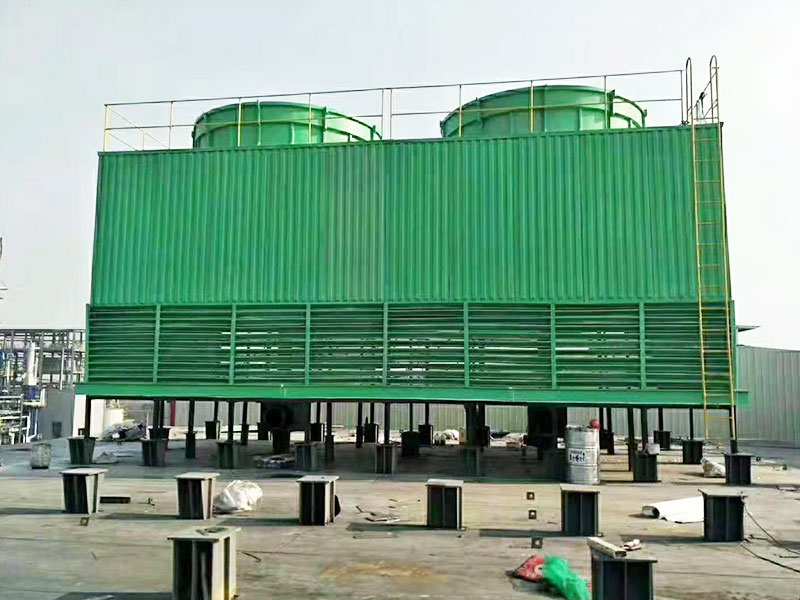
- Confirm the foundation level, anchor locations, and support details against approved drawings.
- Inspect shipment sections, FRP surfaces, fasteners, fill, eliminators, fan parts, and accessories before assembly.
- Verify fan rotation, blade clearance, alignment, lubrication, guards, motor data, and vibration before sustained operation.
- Balance water distribution and confirm that nozzles, basins, strainers, drains, overflow, and make-up controls operate correctly.
- Establish the water management program before regular operation and document baseline water conditions.
- Record inlet and outlet water temperature, flow, ambient wet-bulb condition, motor load, basin level, and control response.
- Train operators on shutdown, winterization, cleaning, safe access, inspection frequency, and abnormal-condition response.
The commissioning plan for an FRP cooling tower should define who verifies mechanical installation, electrical controls, water treatment, and thermal operation. Keep approved drawings, manuals, inspection records, and test results with the site maintenance documentation.
معلومات يجب تضمينها في طلب عرض الأسعار
A useful FRP cooling tower inquiry should include enough data for every bidder to work from the same basis:
- Circulating-water flow and allowable pressure loss
- Hot-water, cold-water, and design wet-bulb temperatures
- Operating schedule, turndown, redundancy, and future capacity requirements
- Make-up water analysis, treatment chemicals, process contaminants, and cycles-of-concentration target
- Site plan, elevation, available footprint, obstructions, and air-intake locations
- Electrical supply, control signals, sound limits, and monitoring requirements
- Wind, seismic, ambient-temperature, icing, UV, and fire-performance requirements
- Required standards, testing, documentation, inspection, delivery limits, and commissioning scope
Also ask for dimensions, operating and shipping weights, fan and motor data, material schedule, general arrangement, nozzle sizes, water volume, access provisions, recommended spares, maintenance tasks, and exclusions. A detailed RFQ reduces assumptions and makes FRP cooling tower proposals easier to compare.
أخطاء الاختيار الشائعة
The first mistake is buying from a nominal capacity label without checking wet-bulb temperature, range, and approach. The second is treating an FRP shell as proof that every internal and external component suits the water chemistry. The third is comparing bids that use different design conditions.
Other frequent problems include ignoring recirculation, underestimating maintenance space, leaving water treatment until startup, assuming drift is eliminated completely, and specifying a sound limit without a measurement location. An FRP cooling tower should be selected as part of a complete heat-rejection and water-management system.
الأسئلة المتداولة
What data is essential for sizing an FRP cooling tower?
At minimum, provide circulating-water flow, hot-water temperature, required cold-water temperature, and design wet-bulb temperature. Site altitude, water quality, operating schedule, sound limits, space, redundancy, electrical supply, and allowable pressure loss may also affect the final configuration.
Does FRP remove the need for water treatment?
No. FRP can improve resistance to many corrosive environments, but scale, biofilm, suspended solids, and biological growth still affect the water system. Treatment, monitoring, cleaning, blowdown, and documented control limits remain necessary.
Is a counterflow tower always better than a crossflow tower?
No. Counterflow and crossflow arrangements differ in footprint, water distribution, air path, pumping head, access, and operating behavior. Select the layout that meets the project’s thermal, space, maintenance, sound, and control requirements.
Can a cooling tower be selected by water flow alone?
No. The same flow can represent very different heat loads and approach conditions. An FRP cooling tower must be evaluated using the complete thermal duty and design weather condition.
What documents should be requested before ordering?
Request the thermal selection, general arrangement, foundation loads, material schedule, motor and fan data, wiring and controls information, installation manual, maintenance requirements, spare-parts list, and any project-required test or compliance documents. Confirm that every document applies to the offered model.
خاتمة
The right FRP cooling tower begins with a defined thermal duty and ends with a maintainable, verifiable system. Range, approach, wet-bulb temperature, water chemistry, component materials, airflow configuration, fan control, drift management, site layout, and service access all belong in the selection process.
Before comparing suppliers, place the design conditions and documentation requirements in one RFQ. Then review each proposal against the same operating point and lifecycle needs rather than relying on a nominal capacity label.
Xinpeng supplies a broader range of منتجات فرب for industrial and infrastructure projects. To discuss an FRP cooling tower, send your flow, temperatures, wet-bulb condition, water analysis, site layout, control requirements, and documentation needs through the صفحة الاتصال.